Epithalon is one of the most frequently searched compounds in longevity research, and for a specific reason: it is studied for its relationship to telomerase, the enzyme most closely associated with cellular aging at the chromosomal level. This overview explains what epithalon is, how researchers describe its mechanism, and what it is studied for — all within a strictly research-focused frame.
Epithalon is also written as epitalon. Both spellings refer to the same molecule, so you will see them used interchangeably across the published literature. Throughout this article we use "epithalon," but everything applies equally to "epitalon."
What It Is
Epithalon is a synthetic tetrapeptide composed of four amino acids in the sequence Ala-Glu-Asp-Gly. It was developed as a synthetic version of epithalamin, a peptide complex naturally produced by the pineal gland. It belongs to the class of short-peptide bioregulators first investigated in Russian gerontology research.
Its primary point of interest for researchers is its studied effect on telomerase, the enzyme responsible for maintaining telomere length. Because telomere shortening is regarded as a fundamental marker of biological aging, a compound examined for its interaction with telomerase draws sustained attention in the longevity field.
How It Works
This mechanism is described as it appears in laboratory and preclinical studies. It reflects what is measured in cell cultures and animal models, not an established outcome in humans.
What Researchers Study It For
These are the areas that appear most often in the epithalon literature. Each is an investigational research direction — a question being studied, not a demonstrated benefit or an approved use.
Common Research Protocols
Epithalon is supplied as a lyophilized (freeze-dried) powder and reconstituted with bacteriostatic water before use. In preclinical studies it is typically administered via subcutaneous injection, with protocols varying by study design. Research by Khavinson and colleagues examined epithalon's effect on telomerase activity and telomere length in human somatic cell cultures. Source
A separate line of work by the same group reported that the peptide activates chromatin in aged cell models, a finding often cited in discussions of its epigenetic effects. Source
Community Interest Areas
Epithalon has attracted strong interest in the longevity research community for its direct association with telomerase — the enzyme most closely tied to biological aging at the chromosomal level. It is frequently studied alongside NAD+ and other cofactors in multi-compound longevity protocols that target both energy metabolism and genomic stability.
Epithalon vs. Pinealon
Both epithalon and Pinealon are short-peptide bioregulators with roots in pineal-gland research, and they are often mentioned together. They are, however, distinct compounds studied for different pathways.
Learn More About Pinealon Read: What Is Pinealon?
Frequently Asked Questions
What is epithalon?
Epithalon (also spelled epitalon) is a synthetic tetrapeptide made of four amino acids, Ala-Glu-Asp-Gly. It is modeled on epithalamin, a natural extract of the pineal gland. In laboratory research it is studied primarily for its relationship to telomerase, the enzyme that maintains telomere length at the ends of chromosomes.
Is epithalon the same as epitalon?
Yes. Epithalon and epitalon are two spellings of the same synthetic tetrapeptide. Published literature uses both spellings interchangeably, along with the sequence name Ala-Glu-Asp-Gly.
What do researchers study epithalon for?
Reported research areas include telomerase activation, telomere length maintenance, cellular senescence and replicative lifespan, and pineal-gland function and circadian regulation. These are investigational areas studied in laboratory and preclinical settings, not approved uses.
Is epithalon studied in relation to aging?
Epithalon is a focus of longevity research because telomere shortening is considered a key biomarker of cellular aging. Studies by Khavinson and colleagues have examined its effect on telomerase activity in cell cultures. This work is preclinical and does not establish any outcome in humans.
How is epithalon used in research protocols?
In published studies epithalon is typically supplied as a lyophilized powder, reconstituted with bacteriostatic water, and administered subcutaneously in preclinical models. Specific protocols vary by study. It is intended for research use only and is not for human consumption.
How much does epithalon cost?
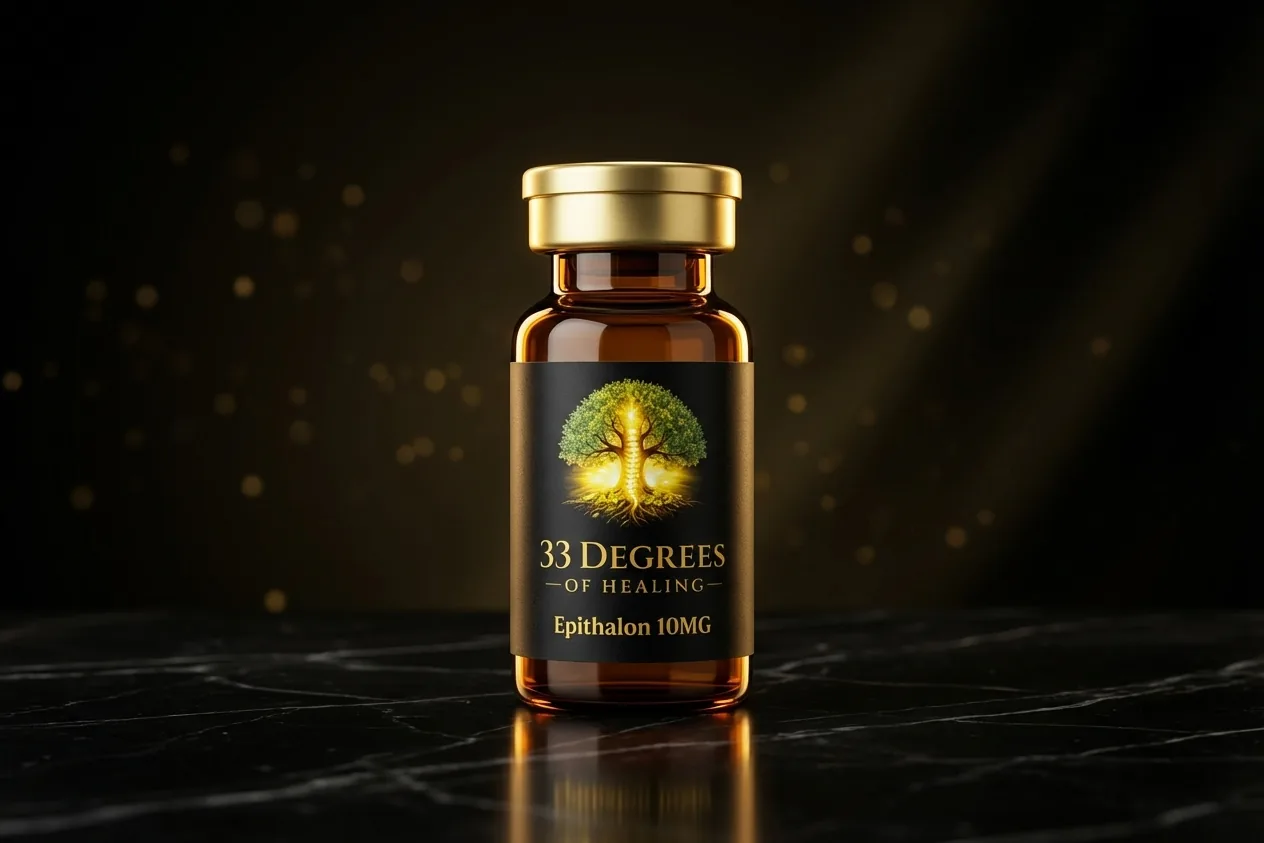
Research-grade epithalon is available from 33 Degrees of Healing at 99% purity with a third-party certificate of analysis. See the epithalon product page for current pricing and availability. All products are sold for research, laboratory, and investigational purposes only.
Key Takeaways
- Epithalon (epitalon) is a synthetic tetrapeptide, Ala-Glu-Asp-Gly, modeled on the pineal peptide epithalamin
- It is studied primarily for its association with telomerase, the enzyme that maintains telomere length at the ends of chromosomes
- Reported research areas include telomere maintenance, cellular senescence, and pineal-gland and circadian pathways — all investigational, none approved uses
- Epithalon and Pinealon are both pineal-derived short peptides but target different pathways: telomeres versus neuronal cell models
- The statements made on this website have not been evaluated by the U.S. Food and Drug Administration (FDA). All products sold by 33 Degrees of Healing are provided strictly for research, laboratory, and investigational purposes only.
Related Research Compounds
Read the Full Mitochondrial Cofactor Review →
Sources
This article is for educational and research purposes only. It is not intended as medical advice. The compounds discussed are research chemicals not approved by the FDA for human use. Always consult qualified professionals and review current regulations before conducting any research.